
Must See Places and Things to do in Wells, England

Set in the rolling hills of Somerset, England, Wells holds the distinction of being England's smallest city, a title it has proudly carried since receiving its city status in 1205. This medieval gem sits at the foot of the Mendip Hills, approximately 20 miles southwest of Bath and 132 miles from London, making it an ideal destination for those seeking to explore the quieter corners of England's West Country.
Check out my services page to see how I can custom design the perfect trip for you.
Getting to Wells

Wells is easily accessible by both car and public transport, though having a car provides the most flexibility for exploring the surrounding Somerset countryside. This is how I like to explore the area. On my last trip to England, we spent a day in Wells on our way from London to the western coast on Somerset. It was the perfect stop along the way. By car, the city is reached via the A39 from Bath or the M5 motorway from Bristol, with the journey taking about 45 minutes from either location. From London, it is about a 3.5 hour drive on either the the M4 or the A303. If you take the A303, it takes you right beside Stonehenge. You can see it clearly from the highway.

For those traveling by public transportation such as trains or uses, it is a little more complicated. Your best bet is to take the train to Bristol or Bath and then take a but in to Wells. Local bus services connect Wells to nearby towns including Glastonbury, Bath, and Weston-super-Mare, making it possible to explore the region without a car.
A City Steeped in History

Wells derives its name from the natural springs that have bubbled up from the ground here for centuries, creating the pools that still exist in the Bishop's Palace gardens today. The city's most remarkable claim to fame is its stunning cathedral, which represents one of the finest examples of Early English Gothic architecture in the country. What makes Wells Cathedral truly special is not just its age, but its completeness—unlike many English cathedrals that were damaged during the Reformation or subsequent conflicts, Wells Cathedral retains most of its original medieval features. I'll talk more about the cathedral later on.
The city of Wells has been a place of Christian worship for over a thousand years, with evidence suggesting that a church existed on the cathedral site as early as 705 AD. Wells became the seat of the Bishop of Bath and Wells in the 12th century, a position that continues today, making it one of the oldest continuously occupied episcopal sites in England. The medieval Bishop's Palace, surrounded by its impressive moat and walls, served as the residence of these powerful church leaders, offering a glimpse into medieval ecclesiastical life.
How Long to Stay

Wells can comfortably be explored in a full day, making it perfect for a day trip from Bath, Bristol, or even London. However, spending one or two nights allows for a more relaxed exploration and the opportunity to experience the city's peaceful evening atmosphere when the day visitors have departed. If you are interested in exploring the wider Somerset region, including nearby Glastonbury, Cheddar Gorge, or the Mendip Hills, you might consider staying two to three days to fully appreciate the area's offerings.
Things to Do in Wells
Wells Cathedral

As mentioned earlier, Wells Cathedral is one of England's most magnificent Gothic cathedrals and the centerpiece of this historic city. Construction began in 1175, and the cathedral showcases the evolution of English Gothic architecture across several centuries. The west front is particularly remarkable, featuring over 300 medieval statues in what was once a brilliantly painted stone gallery depicting biblical scenes and saints. Inside, you will be greeted by the famous scissor arches, which were an ingenious 14th-century engineering solution that were added to prevent the central tower from collapsing under its own weight. The cathedral houses numerous treasures including a 14th-century astronomical clock that still performs its medieval pageant every quarter hour, with knights on horseback jousting. This is the second oldest working clock in the world. The Chapter House, reached by a stunning worn stone staircase, displays exquisite fan vaulting and medieval carvings, while the cathedral's choir stalls and misericords offer intricate details of medieval craftsmanship that reward close inspection.

They perform a choral evensong most days. Be sure to check the schedule ahead of time as they close the cathedral ahead of time to get ready for the performance. We were there on a Sunday when the evensong was at 3:00. We had visited the cathedral earlier, but wandered back in just before 4:00 to hear the end of the evensong. It is always a treat to listen to beautiful music in one of the majestic cathedrals of Europe.
Bishop's Palace

The Bishop's Palace offers a fascinating complement to the cathedral visit, showcasing over 800 years of history within its fortified walls. It represents one of the most complete surviving examples of a medieval bishop's residence in England, surrounded by impressive 13th-century walls and a spring-fed moat. The palace has been home to the Bishops of Bath and Wells for over 8 centuries, with the current structure dating primarily from the 13th and 14th centuries. You can explore the medieval Great Hall, now romantically in ruins, but still imposing with its soaring walls and Gothic windows, which once hosted grand banquets and important ecclesiastical meetings. The palace gardens are particularly enchanting, featuring the natural springs that give Wells its name, creating clear pools where the famous palace swans have learned to ring a bell at the gatehouse when they desire feeding.

The palace also houses a collection of medieval rooms, including the chapel, the Long Gallery, and various chambers that showcase how these powerful medieval church leaders lived. The fortified gatehouse and drawbridge emphasize the palace's dual role as both spiritual center and fortress during turbulent medieval times.
Vicars' Close

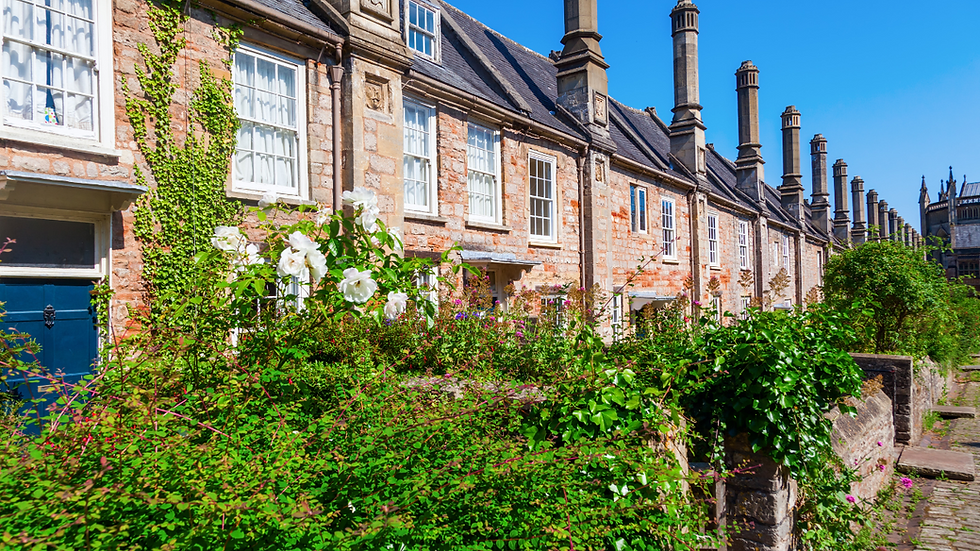
Vicars' Close claims the distinction of being the oldest purely residential street in Europe, representing an extraordinary survival of medieval urban planning. Built in the 14th century specifically to house the Vicars Choral who sang daily services in the cathedral, this cobbled street consists of 27 identical houses that creates a sense of intimacy and unity. The uniformity of the gray stone facades, each with its distinctive medieval doorway and small front garden, creates an almost magical atmosphere that transports visitors back six centuries. What makes Vicars' Close particularly special is that it continues to fulfill its original purpose, with many of the houses still occupied by cathedral staff, maintaining a living connection to its medieval heritage. The street terminates at both ends with significant buildings: the Vicars' Hall at one end, where the residents once dined communally, and a chapel at the other. The preservation is so complete that the street regularly serves as a filming location for period dramas.
Saint Cuthbert's

St. Cuthbert's Church serves as Wells' parish church and represents a fascinating contrast to the grandeur of the cathedral, offering insight into medieval parish life in this ecclesiastical city. Dating primarily from the 15th century, though with earlier origins, St. Cuthbert's is remarkable for its size and elaborate decoration, reflecting the prosperity that Wells enjoyed during the medieval period. The church features one of Somerset's finest towers, constructed in the distinctive local style with elaborate pinnacles and decorative stonework that rivals many cathedrals. Wander inside to discover an impressive array of medieval features including carved wooden roof bosses, ancient stained glass windows, and elaborate stone carving that demonstrates the high level of craftsmanship available in medieval Wells. St. Cuthbert's continues as an active parish church, maintaining centuries of continuous worship while preserving its medieval character and serving the local community as it has done for over 500 years.

During the summer there are a few days that you are able to have a bell ringing demonstration where you are able to try ringing yourself. We were lucky enough to be there on one such day. It was fascinating to learn more about bell ringing. Did you know that there are three ways to ring a church bell? If you are around on Friday nights, you will be treated to the bell ringers practicing their different songs.
Market Place and High Street

Wells Market Place, one of England's most beautiful medieval squares, hosts a bustling market twice weekly on Wednesdays and Saturdays. The square is surrounded by a collection of medieval and Georgian buildings, many now housing independent shops, cafes, and restaurants. The Crown Hotel, with its distinctive coaching inn facade, has been welcoming travelers since the 15th century and provides an excellent base for exploring the city.
Day trips
Wells might be England's smallest city, but it's perfectly positioned for some absolutely brilliant day trips that'll have you exploring everything from mystical legends to dramatic gorges. The beauty of staying in Wells is that you're smack in the middle of Somerset, which means you can wake up in a medieval cathedral city and be standing in prehistoric caves or wandering through Roman baths by lunchtime.

Let's start with the obvious one that everyone talks about – Glastonbury is literally just eight miles down the road. Whether you're into the whole King Arthur and Holy Grail mythology or you just want to see where half a million people descend every summer for one of the world's most famous music festivals, Glastonbury has this incredible mystical atmosphere that's hard to shake off. The abbey ruins are genuinely moving, especially when you think about how this was once one of the most powerful religious sites in medieval England. Make sure to make the climb up Glastonbury Tor as it is worth every huffing step for the views across Somerset.

If you're more of an adventure seeker, Cheddar Gorge is a terrific option and it's only about 15 minutes by car from Wells. This place is jaw-dropping. Limestone cliffs tower 450 feet above you, creating Britain's largest gorge. You can explore the famous caves where Cheddar Man (Britain's oldest complete skeleton) was discovered, or if you're feeling energetic, there are some fantastic walks along the cliff tops. Fair warning though, the steps up to the top will have your legs burning, but the views are spectacular. Plus, you can't leave without trying some proper Cheddar cheese from where it all began.

Bath is the day trip that'll make you feel like you've stepped into a Jane Austen novel, and it's only about 45 minutes away by car or an hour by bus. The Roman Baths are absolutely fascinating – you're literally walking where Romans walked 2,000 years ago, and you can still see the steam rising from the sacred hot springs. The Georgian architecture throughout the city is stunning, particularly the Royal Crescent and the Circus, and if you time it right, you might even catch a Jane Austen festival or Christmas market. Just be prepared for crowds, especially in summer, but honestly, it's worth dealing with the tourists for those incredible honey-colored buildings.
Are you ready to travel to Wells? Contact me at stefanie@eurotravelsbydesign.com and I will custom design your perfect itinerary.


Comments